Toronto's Taalas Breaks Cover With a Hardwired AI Chip That Bakes Models Directly Into Silicon
News Summary
Toronto-based AI chip startup Taalas officially emerged from stealth and unveiled its debut product on Thursday, February 19, 2026 (11:02 AM EST), announcing a $169 million funding round and the launch of its first hardwired AI chip, the HC1.
A New Challenger to Nvidia's AI Dominance
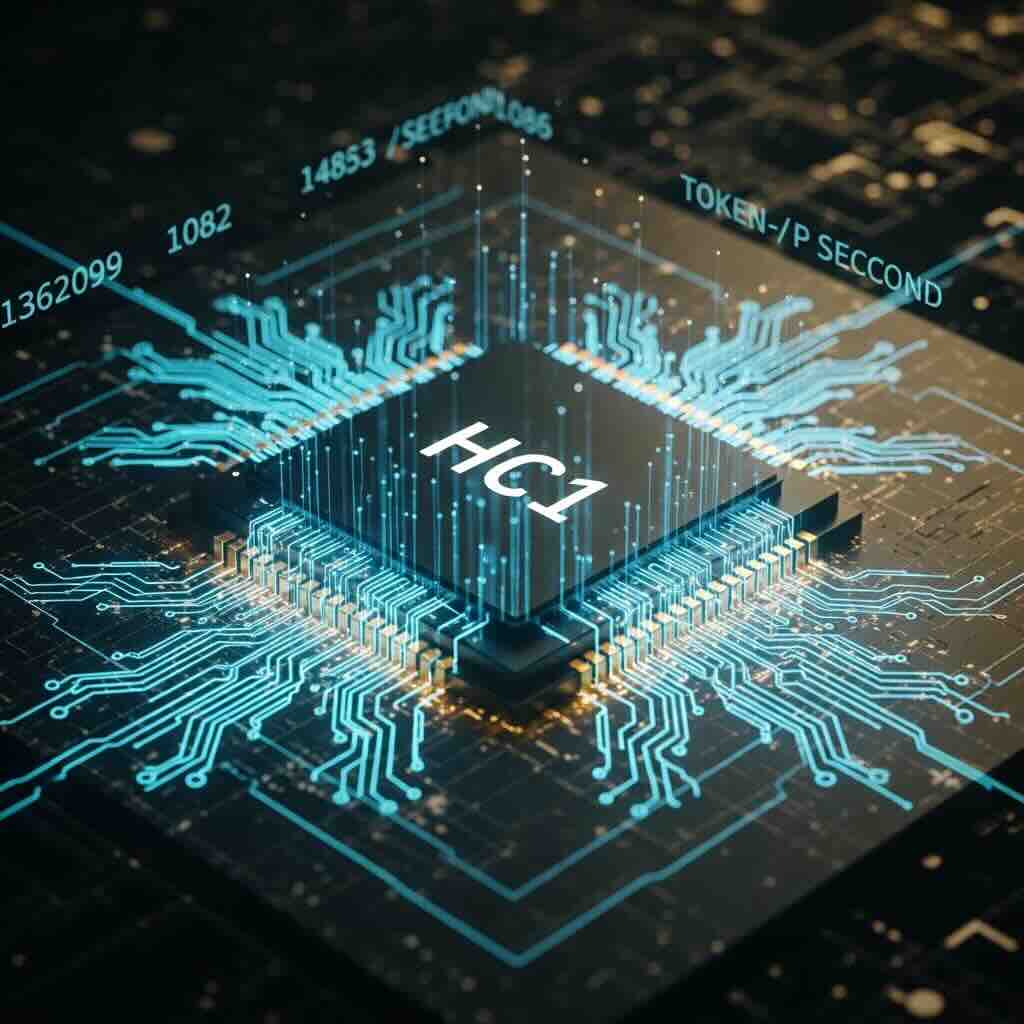
Toronto-based AI chip startup Taalas officially pulled back the curtain on its groundbreaking first product Thursday (EST), announcing a $169 million funding round while unveiling the HC1 — a revolutionary "hardwired" AI processor purpose-built to run Meta's open-source Llama 3.1 8B language model. The disclosure pushes Taalas's total outside funding to approximately $219 million, with backers including Quiet Capital, Fidelity, and veteran semiconductor investor Pierre Lamond.
The announcement sent ripples through the AI hardware community, arriving just weeks after Nvidia finalized a landmark $20 billion deal to license intellectual property from AI inference rival Groq — a move that has reignited investor enthusiasm for specialized AI silicon startups.
The HC1 Chip: Hardwiring Intelligence Into Silicon
At the heart of Taalas's technology is a radical rethink of how AI models run on hardware. Traditional GPUs — the workhorses of AI compute — rely on an "Instruction Set Architecture" (ISA) that physically separates computation from memory. Each time a large language model processes a query, the chip must repeatedly shuttle model weights from High Bandwidth Memory (HBM) to processing cores. Taalas calls this the "Memory Wall," and estimates that this data movement tax accounts for nearly 90% of power consumption in modern AI data centers.
Taalas's solution is to eliminate the memory-fetch cycle entirely. Instead of running a model on a chip, Taalas effectively bakes the model into the chip — physically printing the AI model's weights and architecture directly into the silicon's metal layers. The result is a processor where the model itself becomes the hardware.
The HC1, fabricated by TSMC on its 6-nanometer (N6) process node, is optimized exclusively for Llama 3.1 8B. According to Taalas, it achieves over 17,000 output tokens per second per user — approximately 73 times faster than Nvidia's flagship H200 GPU — while consuming just one-tenth of the power. The company also claims the chip costs 20 times less to build than comparable solutions from Nvidia, Groq, SambaNova, and Cerebras.
From Weights to Silicon in Two Months
One of Taalas's most compelling technical claims is speed of production. Traditional custom AI chip development can take six months or more. Taalas, by contrast, says it can transform any AI model's weights into deployable silicon in approximately two months, working in partnership with TSMC.
The secret lies in design economy: rather than redesigning an entire chip for each model, Taalas only modifies two of the roughly 100 metal layers that compose the chip. This dramatically reduces fabrication time and cost, making custom AI silicon accessible to organizations that could never previously afford bespoke hardware.
This rapid iteration enables what Taalas describes as a "seasonal" hardware cycle — a company could fine-tune a frontier model in spring and have thousands of specialized inference chips deployed by summer.
A Lean Team with a Bold Vision
Perhaps the most striking aspect of Taalas's story is its efficiency. The HC1 was brought to market by a team of just 24 engineers at a total development cost of $30 million — a fraction of the hundreds of millions typically required for custom silicon ventures.
The company was founded in August 2023 by Ljubisa Bajic, a co-founder of AI chip firm Tenstorrent and a former architect at both AMD and Nvidia, alongside engineers Drago Ignjatovic and Lejla Bajic. Taalas has since grown to 25 employees, drawing talent from AMD, Apple, Google, Nvidia, and Tenstorrent. Most recently, Paresh Kharya — formerly Director of AI Infrastructure Product Management at Google Cloud, overseeing GPU and TPU hardware — joined as Vice President of Products.
Roadmap: HC2 and Beyond
Taalas is not stopping at Llama 3.1 8B. The company is already developing its HC2 chip, targeting the Llama 3.1 model with 20 billion parameters. By year-end, Taalas aims to produce a chip capable of running a cutting-edge frontier model such as GPT-5.2. The company has also demonstrated a cluster-based configuration of 30 HC1 chips running DeepSeek's R1 model at 12,000 tokens per second per user.
The HC1 is currently available as both a chatbot demo and an inference API service, with broader commercial deployments expected throughout 2026.
Market Context: The Inference Era Begins
Taalas's emergence signals a broader shift in AI hardware strategy. As the industry transitions from the training phase — where GPU flexibility is paramount — to the inference deployment phase, cost-per-token has become the dominant metric. If Taalas's approach proves scalable, the AI compute market could bifurcate into two tiers: general-purpose training led by Nvidia and AMD, and specialized inference led by model-specific silicon foundries like Taalas.
With $219 million in total funding, a functioning first chip, and an ambitious roadmap, Taalas has positioned itself as one of the most credible challengers to the status quo in AI hardware — and the industry is watching closely.
This article was compiled by the AIBARS editorial team with AI assistance. AI can make mistakes, so please check the original source for anything important. Spotted an error? Email [email protected].